


How Do You Pack for an RV Without Overloading It?
Last Updated: November 4, 2026
Quick Summary
To pack for RV travel without overloading, start with your payload capacity and GVWR, then keep heavy items low and over the axles and fill fresh water tanks last. Weigh your rig at a public scale once loaded and confirm tongue weight stays between 10 and 15 percent of the loaded trailer weight.
- Find payload capacity and GVWR on the sticker inside the driver's door frame or on the trailer tongue.
- Water weighs 8.34 pounds per gallon, so a full 50-gallon fresh tank adds about 417 pounds.
- For a two-day trip, pack one bin per person, one food crate, and a small bag of setup gear.
- Most RV storage bays are 12 to 18 inches tall, so two 10-inch bins stack where one 20-inch bin will not.
- Keep a digital inventory in a phone note listing every bin and its contents, updated after each trip.
Table of Contents
- Start With Weight, Not Stuff: Payload Capacity and GVWR
- How to Pack for RV for 2 Days: A Short-Trip Walkthrough
- The Travel Trailer Essentials List, Room by Room
- What to Pack When Renting an RV (and What the Owner Already Supplies)
- Safety and Emergency Gear You Should Never Skip
- Space-Saving Organization Hacks That Keep Gear From Shifting
- Seasonal Packing Variations and a Digital Inventory Habit
- Get Your Free Printable RV Packing List Before You Load Up
- Frequently Asked Questions
Start With Weight, Not Stuff: Payload Capacity and GVWR
Many RV travelers learn how to pack the hard way: they load everything, then discover the rig sways on turns or the tires run hot. The fix starts before you touch a single bin. Every RV has a payload capacity, the maximum weight of people, water, and gear it can carry. Your GVWR, or gross vehicle weight rating, is the total the fully loaded rig can weigh. The difference between GVWR and the RV's curb weight (the rig with full fuel and fluids but no cargo) is your available payload.
Both numbers sit on a sticker inside the driver's door frame or on the trailer tongue. For a travel trailer, you also need the tow vehicle's payload rating, which is separate from its towing capacity. A common pattern is a tow vehicle that can pull 7,000 pounds but has only 1,200 pounds of payload, and the trailer's tongue weight plus passengers and gear eats that payload fast.
Here is how the math works in practice. Suppose your travel trailer has a GVWR of 7,500 pounds and a dry weight of 6,000 pounds. That leaves 1,500 pounds of payload. A full fresh water tank at 50 gallons adds about 417 pounds (water weighs 8.34 pounds per gallon). Two adults at 350 pounds total, plus a generator at 100 pounds, plus food and clothing at 200 pounds, plus tools and outdoor gear at 150 pounds, adds another 800 pounds. You are now at 1,217 pounds of payload, leaving only 283 pounds of margin. That margin disappears quickly with a case of bottled water or a cast-iron skillet.
A few rules we follow:
- Fill fresh water tanks last, close to home, and only as much as you need for the drive
- Keep heavy items low and over the axles, not in the rear bumper storage
- Never tow over your tow vehicle's rated capacity, and weigh your rig at a public scale once loaded
- Use a tongue weight scale to confirm your trailer's tongue weight stays between 10 and 15 percent of the loaded trailer weight
Watch out: A common mistake is assuming the dry weight on the brochure includes dealer-installed options like awnings, solar panels, or a second battery. Those add hundreds of pounds before you pack a single item.
New to gear weight? Our essential RV gear for beginners guide walks through starter items without the bulk.
How to Pack for RV for 2 Days: A Short-Trip Walkthrough
A two-day trip needs far less than most people bring. The goal is one bin per person, one food crate, and a small bag of setup gear. Here's a short-trip method for how to pack for RV travel without hauling your whole garage.
- Lay everything out first. Sort into sleep, eat, wear, and setup piles.
- Cut each pile in half. Short trips rarely need backups of backups.
- Pack one outfit per day plus one spare. Layer instead of doubling up.
- Load setup gear last. Chocks, blocks, and hoses go near the door.
- Leave the "maybe" pile home. If you didn't use it last trip, skip it.
Two days means two meals cooked on board, max. Keep pantry items simple and shelf-stable.
The Travel Trailer Essentials List, Room by Room
A travel trailer essentials list works best when you build it room by room. That way nothing gets forgotten and nothing gets packed twice.
Kitchen and Pantry Staples
Start with a potable water hose and an inline filter for campground hookups. The two-pack RV inline water filters are designed to help improve the taste and clarity of campground water at compatible connections. Then add:

- Nesting pots and a compact dish set
- Pantry staples: oil, salt, coffee, canned goods
- Collapsible dish tub and drying rack
- Paper towels and trash bags
Skip glass. Skip single-use gadgets. Collapsible everything.
Bedding, Clothing, and Bathroom Basics
Pack bedding for the season, not the year. Two sets of sheets, one blanket, and pillows per sleeper cover most trips. For clothing, layering beats volume: base layer, mid layer, rain shell.
Bathroom basics fit in one shower caddy:
- Quick-dry towels
- Toiletries in a hanging bag
- RV-safe toilet paper
- First aid kit
What to Pack When Renting an RV (and What the Owner Already Supplies)
Knowing what to pack when renting an RV saves you from buying duplicates. Most rentals include bedding, cookware, and hookup hoses. Ask the owner for a written list before you shop.
What renters usually bring:
Two-Pack RV Inline Water Filters with Flexible Hose Protector →
- Personal clothing and toiletries
- Food and drinks
- Phone chargers and entertainment
- Pet supplies, if traveling with animals
If your campground has limited facilities, a portable camping shower makes a solid backup. Confirm what's included first, then pack only the gaps.

Safety and Emergency Gear You Should Never Skip
Safety gear is the one category where we never cut corners. A roadside emergency kit, fire extinguisher, and first aid kit belong in every rig, every trip.
Our non-negotiables:
- Roadside emergency kit with flares and jumper cables
- Fire extinguisher mounted near the exit
- First aid kit, restocked each season
- Tire pressure gauge and a spare
- Flashlight and extra batteries
For a ready-made option, a 31-piece survival gear set covers the basics in one bag. Check expiration dates on extinguishers yearly.
Space-Saving Organization Hacks That Keep Gear From Shifting
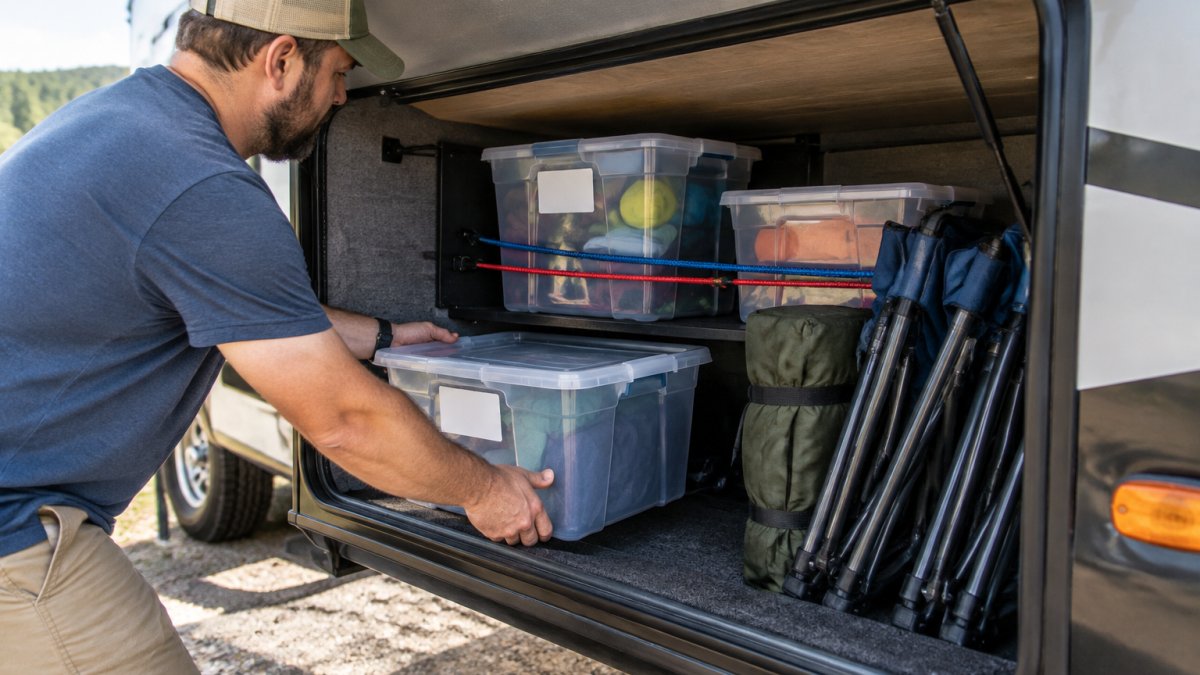
Gear that shifts in transit becomes gear that breaks. The fix is a mix of clear bins, tension rods, and non-slip shelf liner, but the real trick is matching the container to the compartment. Most RV storage bays are 12 to 18 inches tall, so a stack of two 10-inch bins fits where one 20-inch bin will not. Measure your deepest cabinet and buy bins that leave a two-inch gap for your fingers to grab.
Our favorite space-savers, with the mechanism behind each:
- Clear stackable bins with latching lids so you can see contents and the lid stays on over washboard roads. Look for bins with a flat top that accepts a second bin without sliding.
- Tension rods placed vertically in cabinets to hold cutting boards, sheet pans, and folded chairs upright, which stops them from sliding forward when you brake.
- Non-slip liner under every shelf and in every drawer. The rubbery mesh grips both the shelf and the item, and it costs less than a dollar per foot.
- Collapsible bins that fold flat when empty, useful for laundry and dirty gear, but they do not stack well when full, so reserve them for soft items.
- Quick-dry microfiber towels that pack small and dry fast, but they hold static and pet hair, so store them in a mesh bag away from clothing.
- Over-the-door shoe organizers on the bathroom door for toiletries, chargers, and small tools. The pockets keep small items visible and off the counter.
A cordless handheld vacuum can help with sand and pet hair between stops.

Watch out: Bungee cords stretched across an open shelf can pop loose on rough roads. Use a cargo bar or a tension rod that wedges against the cabinet walls instead.
For a digital inventory habit that pairs with these bins, see the next section.
Seasonal Packing Variations and a Digital Inventory Habit
Your packing list should change with the season. Summer means fans, bug spray, and extra water. Winter means insulation, heated hoses, and cold-weather layers.
We also keep a digital inventory. A simple phone note listing every bin and its contents saves hours of searching. Update it after each trip.
| Season | Add | Remove |
|---|---|---|
| Summer | Fans, bug spray, sun shade | Heavy blankets |
| Fall | Rain gear, extra layers | Water toys |
| Winter | Heated hose, insulation | Summer clothing |
| Spring | Screens, cleaning supplies | Winter gear |
Get Your Free Printable RV Packing List Before You Load Up
Packing light takes practice, but the payoff is a rig that handles well and a trip that runs smooth. Start with weight, build room by room, and let the season guide what goes in.
At FieldToStream, we're a veteran-owned small business that prioritizes items stocked in U.S. warehouses for faster delivery, with honest product explanations and responsive, personal customer service.
Get started with FieldToStream and load up with gear that fits your rig and your trip.
Frequently Asked Questions
What should I pack for my first RV trip?
Start with the systems that keep the rig running: a potable water hose, sewer hose, leveling blocks, wheel chocks, and a surge protector. Then add a roadside emergency kit, first aid supplies, and a fire extinguisher. For living space, bring kitchen staples, bedding, and clothing you can layer. Weigh your loaded rig at a public scale before your first trip so you know how much payload room is left for food, water, and people.
How much clothing should I pack for an RV trip?
A common approach is roughly one week of clothing regardless of trip length, then plan a laundry stop. Clothing is one of the heaviest categories in an RV, so pack layers you can mix and match rather than outfits for every day. Roll items to save drawer space, and keep a small bag for dirty laundry. If you pack for RV travel in cooler months, bulky jackets eat storage fast, so choose one versatile outer layer.
How do you keep things from moving around in an RV while driving?
Secure everything before you roll. Use non-slip shelf liner in cabinets, tension rods to hold items in place, and clear bins with latched lids in storage bays. Bungee cords keep chairs and coolers from sliding, and cabinet latches should be checked before every departure. Heavy items belong low and over the axles, not in overhead cabinets. A quick walk-through after loading, pushing on shelves and bins, shows you what still needs strapping down.
What should you not pack in an RV?
Leave behind items that add weight without earning it: full-size appliances, hardcover book collections, and duplicate cookware. Avoid packing heavy tools you will not use, and do not travel with full water tanks unless you need them, since water weighs about 8.3 pounds per gallon. Also skip anything flammable stored near the stove or water heater. If you are renting, check the owner's rules first, since some rentals prohibit certain items like grills or space heaters.

Sample Block Quote
Praesent vestibulum congue tellus at fringilla. Curabitur vitae semper sem, eu convallis est. Cras felis nunc commodo loremous convallis vitae interdum non nisl. Maecenas ac est sit amet augue pharetra convallis nec danos.
Sample Paragraph Text
Praesent vestibulum congue tellus at fringilla. Curabitur vitae semper sem, eu convallis est. Cras felis nunc commodo eu convallis vitae interdum non nisl. Maecenas ac est sit amet augue pharetra convallis nec danos dui.
Cras suscipit quam et turpis eleifend vitae malesuada magna congue. Damus id ullamcorper neque. Sed vitae mi a mi pretium aliquet ac sed elitos. Pellentesque nulla eros accumsan quis justo at tincidunt lobortis denimes loremous. Suspendisse vestibulum lectus in lectus volutpat, ut dapibus purus pulvinar. Vestibulum sit amet auctor ipsum.
