


How to Choose Reliable Camping Gear That Lasts
Last Updated: November 1, 2026
Quick Summary
To choose reliable camping gear, judge materials, construction, tested specifications, and how well each item matches your actual camping conditions rather than its price. Reliable camping gear is a match between equipment and conditions, so check stated waterproof ratings, comfort ratings, and R-values before buying.
- A waterproof rating is a threshold in millimeters of water column, not a comfort score.
- Pick a sleeping bag by its comfort rating, not its lower-limit rating.
- An R-value of 2 on a sleeping pad suits mild weather; colder ground calls for more.
- Many three-season campers aim for a base weight of 15-20 pounds for comfort.
- Rinse and fully dry tents before storage to prevent coating damage and mildew.
Table of Contents
- What Makes Camping Gear Reliable: A Practical Evaluation Framework
- How to Choose a Camping Tent for Real Weather Protection
- How to Choose a Sleeping Bag by Temperature Rating and Fit
- Sleeping Pads and Ground Insulation: The Comfort and Warmth Layer
- Cooking Gear, Backpacks, and Storage: Matching Capacity to Your Trip
- Your Camping Gear Checklist for a Weekend Trip
- Camping Gear Maintenance Tips to Extend Equipment Life
- Testing and Maintaining Your Gear Before You Leave
- Frequently Asked Questions
What Makes Camping Gear Reliable: A Practical Evaluation Framework
Reliable camping gear is equipment that performs its core job in the conditions you actually camp in, trip after trip, without failing at the worst moment.
Most buyers rank gear by price first. That is backwards. A cheap tarp that sheds rain for years beats a costly tent with a thin floor that leaks in the first storm. Reliability lives in the details, not the receipt.
Why Price Is Not the Same as Reliability
Price signals brand marketing more than durability. A higher cost often buys lighter materials, which can mean less abrasion resistance, not more. The Federal Trade Commission's guidance on environmental marketing claims reminds shoppers that vague "premium" or "all-weather" language means little without specifics. Instead of asking what gear costs, ask what it is made of and what it is rated for.
Our four-part framework:
- Materials: nylon, polyester, and Oxford fabrics with stated coatings
- Construction: zippers, seams, poles, and reinforced stress points
- Tested specs: waterproof ratings, temperature ratings, R-values
How to Choose a Camping Tent for Real Weather Protection
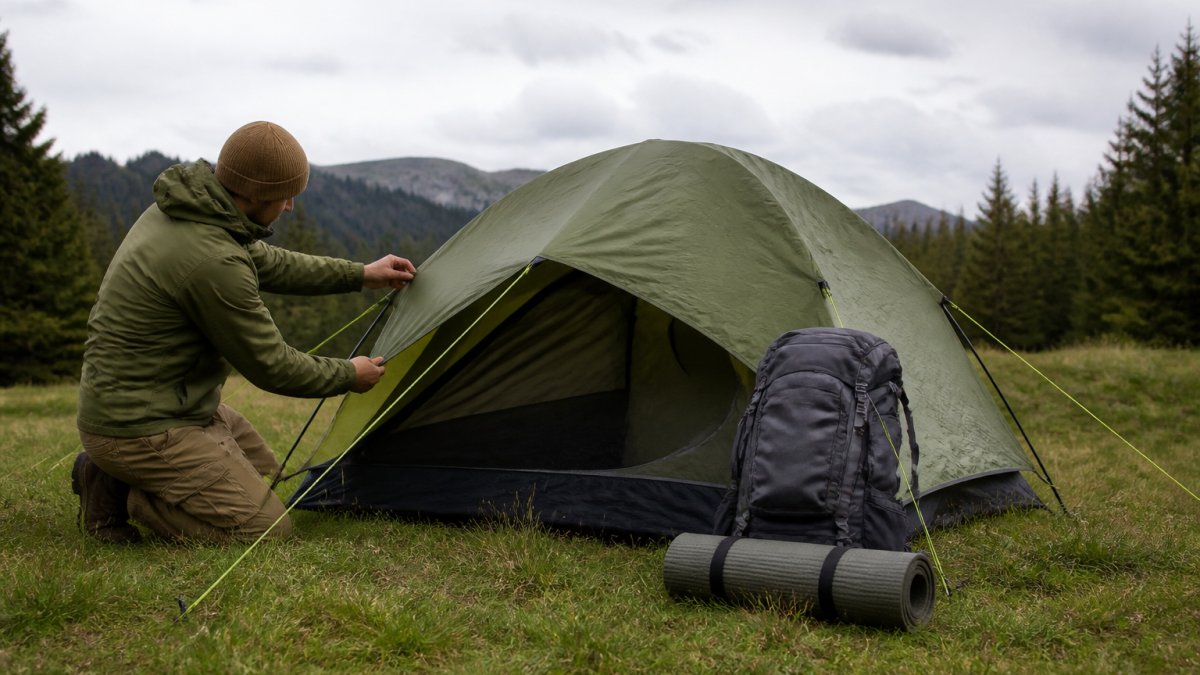
To choose a camping tent, check the rain fly coating, floor waterproof rating, and pole material before anything else. These three specs decide whether you stay dry in a real storm. Ignore the marketing photos of sunny meadows.
Rain Fly, Floor, and Pole Specs That Matter
Look for a rain fly with a polyurethane coating and a stated rating. You can see these specs on a real tent like the Trail 43 Convertible 3-4 Person Backpacking Tent, which lists a PU 1500 mm fly and floor, DAC aluminum poles, and YKK zippers, and meets the supplier-stated CPAI-84 flame-resistance standard.

For a lightweight backup or a sun and rain shelter over a picnic table, a PU 2000mm camping tarp shelter gives you a stated water-resistance rating and packs small.
How to Read Waterproof Ratings Instead of Guessing
A waterproof rating is measured in millimeters of water column (mm) and describes how much water pressure a fabric resists before it leaks. The number is not a comfort score; it is a threshold. A common pattern is:
- 1,000-1,500 mm: light rain and condensation protection for fair-weather trips
- 1,500-3,000 mm: sustained rain and typical three-season use
- 3,000 mm and up: heavy or wind-driven rain, exposed sites, and longer trips
Two cautions. First, a high rating on the fly means little if the floor is thin, groundwater and packed-in moisture attack from below. Second, coatings degrade with UV exposure and abrasion, so a 1,500 mm tent stored wet and pitched in full sun every weekend can underperform a well-cared-for 1,200 mm tent. Check whether the manufacturer states the rating for the fly and floor separately, and whether seams are taped or seam-sealed at the factory.
Pole Material, Seams, and Zippers
Poles carry the wind load. Aluminum poles are generally lighter to carry than fiberglass, which is why many campers prefer them. Check the pole diameter, thicker is stronger but heavier. Seams should be taped or sealed, especially where the fly meets the pole sleeves. Zippers should be name-brand because a failed zipper can end a trip faster than a leak.
Match the Tent to Your Conditions, Not the Catalog
Consider these conditions before you buy:
- Fair-weather weekend camping: a single-wall or basic double-wall tent with a 1,000-1,500 mm fly is enough; prioritize ventilation and easy setup.
- Three-season, mixed weather: double-wall tent, taped seams, 1,500-3,000 mm fly and floor, aluminum poles, and a full-coverage fly that reaches near the ground.
- Exposed or storm-prone sites: full-coverage fly, 3,000 mm or higher ratings, geodesic or multi-pole structure, and guylines with tensioners.
Durability Details That Predict Longevity
Check the denier (fabric weight) of the floor, since higher-denier fabrics generally resist abrasion better than lighter ones. Look for reinforced stress points at stake loops and pole intersections. Confirm whether a footprint is included or available, since a footprint can extend floor life. Finally, read the warranty terms and check repairability before deciding on price.
Waterproof ratings are thresholds, not comfort scores, so match the number to your conditions.
| Waterproof rating | Best for | Note |
|---|---|---|
| 1,000-1,500 mm | Light rain and condensation on fair-weather trips | Enough for a basic double-wall tent |
| 1,500-3,000 mm | Sustained rain and typical three-season use | Pair with taped seams and aluminum poles |
| 3,000 mm and up | Heavy or wind-driven rain, exposed sites, longer trips | Check fly and floor ratings separately |
How to Choose a Sleeping Bag by Temperature Rating and Fit
Choose a sleeping bag by its comfort rating, not its lowest number. The comfort rating is the temperature at which an average sleeper stays warm. The lower-limit rating is the edge of survival, not comfort.
Comfort Rating vs. Lower-Limit Rating
A bag tested to the ISO 23537-1 standard publishes both numbers, so you can compare fairly. Pick a comfort rating a bit below your expected nighttime low. Fit matters too: a bag that is too short loses warmth at the feet. The Settler 3-Season Synthetic Sleeping Bag lists a 29°F comfort rating and an 18°F lower-limit rating, and is available in three lengths with left- or right-side zippers.

Sleeping Pads and Ground Insulation: The Comfort and Warmth Layer
Ground steals heat faster than air. A sleeping pad is your warmth layer, and its R-value tells you how well it insulates. An R-value of 2 suits mild weather. Colder ground calls for more.
Trail 43 Convertible 3–4 Person Backpacking Tent →
Thickness adds comfort. The Camfy P3 3-Inch Backpacking Sleeping Pad pairs a 3-inch surface with an R-value of 2, a pump sack for easy inflation, and a repair kit.

Cooking Gear, Backpacks, and Storage: Matching Capacity to Your Trip
Match your pack to your trip length and your stove to your meals. A weekend pack runs smaller than a week-long one. Carry only cookware you will actually use.
Pack Volume: A Practical Starting Point
Pack capacity is measured in liters, and the right number depends on how many days you carry and whether you carry group gear. A common pattern among experienced campers:
- Day hikes: 15-30 liters for layers, water, snacks, and a first-aid kit
- Overnight or weekend: 40-55 liters for a solo camper with a three-season kit
- Three to five days: 55-70 liters, or 65-80 liters if you carry a bear canister or group cookware
These are starting points, not rules. Bulky synthetic sleeping bags and foam pads eat volume; a down bag and inflatable pad free up 10-15 liters. If you camp with a partner, split the tent, stove, and cookware so neither pack carries all the group weight.
Packed Weight and Ease of Setup
Weigh your full pack before you leave. A pack that fits well carries heavy loads better than a light pack that rubs.
A useful check is base weight, everything except food, water, and fuel. Many three-season campers aim for a base weight in the 15-20 pound range for comfort, though ultralight setups run lower and winter or family setups run higher.
Stove and Cookware Choices by Trip Type
- Canister stoves: simplest and fastest for boiling water; best for one or two people and trips where fuel is easy to buy. Check canister availability before a long trip.
- Liquid-fuel stoves: reliable in cold weather and at altitude, where canister pressure drops; more fiddly to prime and maintain.
- Wood-burning or multi-fuel stoves: useful for emergencies and long trips where fuel resupply is uncertain, but check local fire regulations before use.
For cookware, a 1-liter pot suits one person; 1.5-2 liters suits two. Nesting pots and a lid that doubles as a pan save space. Carry only the fuel you need, one small canister typically covers a weekend of boiling water for one or two people, and store fuel away from food and sleeping gear.
Storage and Packing Systems
Stuff sacks and compression bags can help you organize gear by category (sleep system, kitchen, clothing, repair). Keep the heaviest items close to your spine and above the hip belt. Line the pack with a trash bag or use a pack cover in wet weather; a wet sleeping bag is the most common trip-ending failure. At home, store packs loosely filled and off the floor, and never store food or scented items in a pack between trips.
Your Camping Gear Checklist for a Weekend Trip
Pack from a checklist so nothing critical stays home. Build it once, then adjust by season.
- Tent with rain fly, stakes, and guy lines
- Sleeping bag rated for the forecast
- Sleeping pad with a suitable R-value
Camping Gear Maintenance Tips to Extend Equipment Life
Camping gear maintenance tips come down to clean, dry, and store. Dirt wears fabric. Moisture grows mildew. Sun breaks down coatings over time. Follow the American Camping Association's camping safety resources for broader trip prep.
- Rinse and fully dry tents before storage
- Loosen sleeping bag compression between trips
- Wipe poles and check zippers for grit
Testing and Maintaining Your Gear Before You Leave
Setting up your tent and inflating your pad at home before every trip is a good habit. Pitch in the yard, check seams, and confirm every stake and guy line is present. This is the step most people skip, and it is the one that saves a trip.
Watch out: storing a damp tent in its bag for months can rot the coating and leave a permanent smell.
Frequently Asked Questions
How do I know if camping gear is good quality?
Look for measurable specifications rather than marketing labels. A reliable tent lists its fabric denier, hydrostatic head rating, and pole material. A reliable sleeping bag cites an ISO 23537-1 or EN 13537 test and shows both comfort and lower-limit ratings. Check that seams are taped, zippers are name-brand, and stakes and repair kits are included.
What camping gear should beginners buy first?
Start with shelter, sleep, and safety: a three-season tent, a sleeping bag rated for the temperatures you expect, and an insulated sleeping pad. Add a first-aid kit, a headlamp, and a basic cookware set. Use a camping gear checklist to avoid overbuying. FieldToStream's Trail 43 tent, Settler sleeping bag, and Camfy P3 pad cover the core three, and you can add a tarp shelter for rain protection as your trips grow longer.
Is expensive camping gear always more reliable?
No. Price often reflects brand marketing, but reliability comes from specific materials and construction. A $55.99 sleeping pad with a stated R-value and a repair kit can outperform a costlier pad with vague claims. Compare temperature ratings, fabric denier, water-resistance numbers, and warranty terms instead of price tags. FieldToStream selects gear from independent suppliers.
How can I check whether camping gear will last?
Inspect stitching, zippers, and coatings before your first trip, then test your setup at home. Pitch the tent, inflate the pad, and check the sleeping bag's zipper and draft tube. After each trip, clean and dry everything fully, store gear loosely rather than compressed, and repair small tears early. Following camping gear maintenance tips like these keeps nylon and polyester fabrics, zippers, and coatings working for many seasons.
Reliable gear should not be a gamble. FieldToStream, a veteran-owned small business, stocks gear chosen by experienced outdoor enthusiasts and shipped from U.S. warehouses for faster delivery. We give honest product explanations and personal service, so you can pack with confidence. Get started with FieldToStream and get out there.

Sample Block Quote
Praesent vestibulum congue tellus at fringilla. Curabitur vitae semper sem, eu convallis est. Cras felis nunc commodo loremous convallis vitae interdum non nisl. Maecenas ac est sit amet augue pharetra convallis nec danos.
Sample Paragraph Text
Praesent vestibulum congue tellus at fringilla. Curabitur vitae semper sem, eu convallis est. Cras felis nunc commodo eu convallis vitae interdum non nisl. Maecenas ac est sit amet augue pharetra convallis nec danos dui.
Cras suscipit quam et turpis eleifend vitae malesuada magna congue. Damus id ullamcorper neque. Sed vitae mi a mi pretium aliquet ac sed elitos. Pellentesque nulla eros accumsan quis justo at tincidunt lobortis denimes loremous. Suspendisse vestibulum lectus in lectus volutpat, ut dapibus purus pulvinar. Vestibulum sit amet auctor ipsum.
