


Essential RV Gear for Beginners: 2026 Starter Guide
(in that orderTable of Contents
- What Gear Do You Actually Need for Your First RV Trip?
- Your RV Essentials Checklist: What to Buy First, Later, and Skip
- RV Hookup Essentials: Water, Sewer, and Electrical Gear
- Leveling, Stabilizing, and Tire Safety Gear
- RV Safety Equipment and Emergency Kit Beyond Tire Changes
- The RV Tool Kit Every Beginner Should Carry
- Setup and Teardown: A Printable Routine for Arrival and Departure
- Conclusion: Start With the Basics and Get Out There
- Frequently Asked Questions
Last Updated: October 6, 2026
What Gear Do You Actually Need for Your First RV Trip?
Essential RV gear for beginners falls into three categories: safety and hookup equipment, comfort items, and tools for campsite problems.
The biggest mistake new owners make is buying everything at once. The RV Industry Association's beginner resources offer a solid starting point for understanding how your specific RV type changes your gear list.
Gear needs differ by campsite type: a full-hookup site needs little beyond hoses and cords, while boondocking demands power, water storage, and waste management.
Your RV Essentials Checklist: What to Buy First, Later, and Skip
The RV essentials checklist below separates true must-haves from items to add later, using priority tiers with cost ranges and compatibility checks.
Tier 1: Buy Before Trip One (Safety and Hookup)
These are the items we recommend having before your first trip.
| Item | Typical Cost Range | Compatibility Check Before Buying |
|---|---|---|
| Fresh-water hose (25 ft) | $20-$45 | Match the fitting to your city water inlet; most are standard 3/4-inch garden thread |
| Water pressure regulator | $10-$30 | Confirm your rig's recommended inlet pressure; most manufacturers spec 40-50 PSI |
| Inline water filter | $20-$60 | Check flow rate against your hose diameter |
| Sewer hose kit (15-20 ft) | $30-$80 | Measure from your dump valve to the typical pedestal distance at sites you plan to use |
| Nitrile gloves (box) | $10-$20 | None, buy a size that fits snugly |
| RV toilet paper | $8-$20 | Confirm it is labeled septic-safe or rapid-dissolving |
| Leveling blocks (set) | $25-$60 | Check your tire width; blocks must support the full contact patch |
| Wheel chocks (pair) | $15-$40 | Match chock height to your tire diameter |
| Digital tire gauge | $10-$30 | Confirm the range covers your rig's recommended cold pressure |
| Surge protector (30A or 50A) | $80-$300 | Match the amperage to your rig's shore power cord, a 30A protector will not fit a 50A pedestal |
| Power adapters (30-to-50 and 50-to-30) | $15-$40 each | Verify the plug style on your rig before ordering |
Do not economize on the sewer hose or surge protector: a split hose is a health hazard, and a failed protector means a fried converter.
Tier 2: Add After Two or Three Trips
These items solve problems you will not know you have until you have camped a few times.
- Portable power station or generator ($200-$1,500 depending on capacity), only needed for boondocking or dry camping. Match the watt-hour capacity to what you actually want to run; a 300Wh unit handles phones and a small fan, not an air conditioner.
- Portable refrigerator ($200-$600), a comfort upgrade once you know your power budget. Confirm it runs on both 12V DC and 110V AC if you want flexibility.
- Cordless handheld vacuum ($40-$120), worth it for pet owners and families. Check runtime against the size of your rig.
Tier 3: Optional or Skip Entirely
Some gear is marketed to beginners who do not need it:

- Dedicated RV GPS, a phone with an RV-height-aware app often does the job.
- Portable ice maker, consumes power and space; campground ice is usually cheaper.
- Fancy leveling systems, manual blocks work fine until you know your rig's quirks.
How to Match Gear to Your RV Type and Campsite
- Motorhome at a full-hookup site: You need hoses, cords, a surge protector, leveling blocks, and chocks. Little else.
- Travel trailer at a full-hookup site: Add a weight-distributing hitch check, a tongue jack block, and a way to verify your tow vehicle's payload rating.
- Any rig boondocking: Add fresh-water storage (jerry cans or a bladder), a way to manage gray water, a power source, and a plan for waste. This is where the Tier 2 items become Tier 1.
Start with Tier 1; everything else can wait.
RV Hookup Essentials: Water, Sewer, and Electrical Gear
RV hookup essentials connect your rig to campsite utilities safely. Getting these wrong causes contaminated water, blocked sewer lines, and fried electronics.
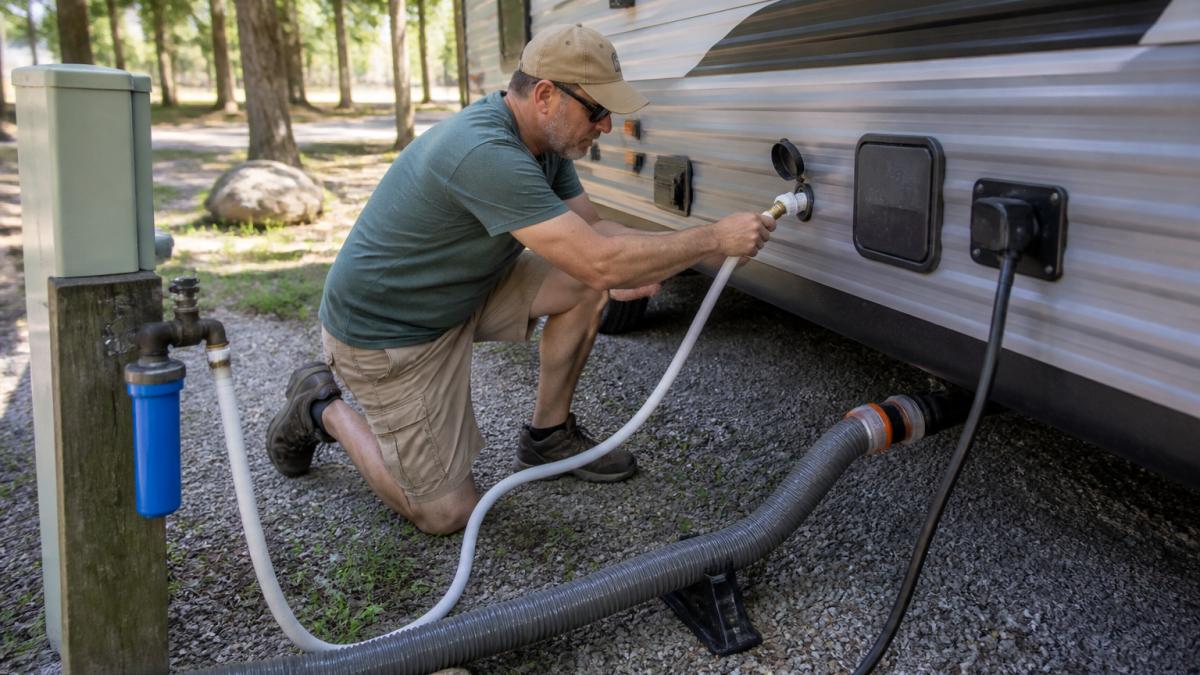
Fresh-Water Hoses and Potable-Water Handling
A fresh-water hose is a drinking-water-safe hose, typically white or blue, that will not leach chemicals into your supply. Never use a garden hose, it is not rated for potable water.
Pair the hose with a water filter and a pressure regulator. The CDC guidance on drinking water safety explains why potable-water handling matters, especially for families with young children or immune-compromised travelers.
Sewer Hoses and Waste-Dumping Supplies
A sewer hose carries black and gray tank waste to the dump station. Buy a sturdy, crush-resistant hose.
Keep dedicated nitrile gloves and RV toilet paper on hand; household toilet paper can clog your black tank. Store sewer gear in a separate sealed bin from fresh-water equipment.
Electrical Hookups, Adapters, and Surge Protection
Electrical hookups come in 30-amp and 50-amp service. Your rig's plug determines which you need, but a power adapter lets you connect to either, carry both a 30-to-50 and a 50-to-30.
We strongly recommend using an RV surge protector or electrical management system (EMS).. A portable power station or generator keeps essentials running. FieldToStream stocks a SBAOH P302 300W 296Wh Portable Backup Power Station that handles phones, laptops, small fans, and compatible portable refrigerators within its 300W continuous output limit.

Leveling, Stabilizing, and Tire Safety Gear
Leveling and tire gear prevent the two most common causes of RV damage: an unlevel rig and a blown tire.
Carry these items:
- Leveling blocks or ramps to raise low wheels on uneven sites
- Wheel chocks on both sides of at least one axle, always
- A digital tire gauge checked before every departure
- A tire pressure monitoring system (TPMS) for larger rigs
- A spare tire, jack, and lug wrench rated for your rig's weight
Underinflated tires overheat and fail, and RV tires often sit for months between trips, accelerating sidewall cracking.
For a full review of tire and towing safety, the National Highway Traffic Safety Administration's tire safety page covers load ratings and inspection basics.
RV Safety Equipment and Emergency Kit Beyond Tire Changes
RV safety equipment goes beyond tires: every rig should carry a fire extinguisher rated for grease and electrical fires, a carbon monoxide detector, a smoke alarm, and a first-aid kit.
Fire and Carbon Monoxide Safety
- Fire extinguisher: Look for a rating that covers both Class B (flammable liquids) and Class C (electrical) fires. Mount it near the exit, not in a compartment you have to open.
- Carbon monoxide detector: Required in most RVs and worth testing monthly. CO is odorless and can build up from a generator, furnace, or a neighboring rig's exhaust.
- Smoke alarm: Test before every trip. Replace batteries on a schedule, not when it chirps.
Verify all of these yourself on your first walkthrough.
VEVOR Portable Refrigerator 37 Quart(35 Liter),12 Volt Refrigerator App →
First-Aid Kit: What Belongs Inside
FieldToStream carries a 173-Piece Portable Camping First-Aid Kit with bandages, tape, scissors, tweezers, a cold pack, and an emergency blanket. Review contents on arrival, replace anything used, and add personal medications.
Beyond the kit itself, add:
- A written list of allergies and current medications for each traveler
- A card with your primary care provider's phone number
- Tick removal tools if you camp in wooded areas
Roadside Visibility and Breakdown Safety
If you break down on a shoulder, being seen matters.
- Reflective triangles or flares: Place them behind the rig, farther back than you think you need.
- High-visibility vest: Keep one within reach of the driver's seat, not in a rear compartment.
- Flashlight or headlamp with spare batteries: A headlamp keeps both hands free while you work.
Weather and Emergency Communication
Cell coverage is not guaranteed at many campsites.
- NOAA weather radio: Picks up alerts when cell service does not.
- Satellite messenger or personal locator beacon: Worth considering for remote boondocking. These devices send an SOS without cell signal.
- Portable power bank: Keeps your phone alive when the rig's battery is the problem.
The Rest of the Kit
Beyond first aid and communication, pack:
- A basic roadside kit with triangles or flares
- A flashlight and spare batteries
- A fire extinguisher mounted near the exit
The RV Tool Kit Every Beginner Should Carry
An RV tool kit should handle the small repairs that would otherwise end a trip, not a full mechanic's set, just the tools for the handful of things that actually break.
Pack a screwdriver set with Phillips and flathead bits, an adjustable wrench, pliers, a utility knife, duct tape, electrical tape, zip ties, and a multi-bit hex key set. Add a small level, a headlamp, and spare fuses matched to your rig.
Two extras earn their space. FieldToStream's 120W Cordless Handheld Vacuum handles sand, crumbs, and pet hair with brush and crevice nozzles. FieldToStream's VEVOR Portable Refrigerator keeps food cold without draining your battery, running on 12/24V DC or 110-240V AC with dual-zone cooling.

Setup and Teardown: A Printable Routine for Arrival and Departure
A repeatable setup and teardown routine prevents the two most expensive beginner mistakes: driving away with something connected, and forgetting to secure gear before towing.
Arrival routine:
- Park and chock the wheels before unhitching
- Level side to side, then front to back
- Connect your water, sewer, and electrical hookups, checking each connection as you go.
Departure routine:
- Close slides and awning
- Disconnect and properly stow your water, sewer, and electrical connections.
- Secure and stow all hoses and cords
Print this list and keep it in the rig.
Conclusion: Start With the Basics and Get Out There
The hardest part of your first RV trip is deciding what to buy. Start with water, waste, power, and tire gear, add safety equipment, and let your first few trips tell you what comfort items you want.
FieldToStream is a veteran-owned small business that selects practical gear from independent suppliers, prioritizing items stocked in U.S. warehouses for faster delivery. We explain what each product does and why, and we answer questions personally rather than with a script.
Frequently Asked Questions
What gear do you need for your first RV trip?
Start with the systems you cannot camp without: a potable-water hose and water filter, a sewer hose with nitrile gloves, a 30-amp or 50-amp power adapter and surge protector, leveling blocks, and a tire pressure gauge. Add a basic RV tool kit, a first-aid kit, and a printed setup and teardown checklist. Everything else, such as a portable refrigerator, generator, or power station, can wait until you know how you actually camp.
What are the must-have RV accessories for beginners?
The must-haves are the items that stop a trip from going wrong: a fresh-water hose rated for potable water, a water pressure regulator, a sewer hose kit, disposable nitrile gloves, a surge protector matched to your rig's amperage, leveling blocks, wheel chocks, and a tire pressure gauge. A cordless handheld vacuum and a compact first-aid kit round out the list. Buy these before your first trip and add comfort items later as your routine settles.
What should be in an RV emergency kit?
Go beyond a spare tire and lug wrench. Pack a 173-piece first-aid kit for minor injuries, an emergency blanket, a cold pack, a flashlight or headlamp with spare batteries, reflective triangles, a fire extinguisher rated for your rig, and a basic tool kit with screwdrivers, pliers, and tape. Add any personal medications and a written emergency contact list. Check the kit before every trip and replace anything used or expired.
What tools should every RV owner carry?
At minimum: a lug wrench that fits your wheel nuts, a jack rated for your RV's weight, a tire pressure gauge, screwdrivers in flathead and Phillips, adjustable pliers, a utility knife, electrical tape, and zip ties. Add a multi-bit driver and a small socket set for interior fittings. Keep everything in one bag so you are not searching through storage bins at a roadside stop. Practice using the jack at home before you need it on the road.
Do you need a water pressure regulator for an RV?
Yes. Campground water pressure varies widely, and a sudden spike can damage your RV's plumbing and fittings. A water pressure regulator screws onto the campground spigot before your fresh-water hose and keeps pressure at a safe level for your rig. Pair it with a potable-water hose and an inline water filter. This is one of the cheapest pieces of RV gear you can buy and one of the most likely to save you a repair bill.
What supplies do you need to hook up an RV at a campsite?
For a full-hookup site you need three connections: water, power, and sewer. Bring a potable-water hose, a pressure regulator, and a water filter for the water side; a surge protector and the correct power adapter for 30-amp or 50-amp service; and a sewer hose with a clear elbow, plus nitrile gloves for dumping. Add leveling blocks and chocks for the site itself. Keep these in one labeled bin so setup takes minutes, not an hour.
What RV gear can beginners skip at first?
Skip the generator, the portable refrigerator, and the large power station until you know how you camp. If you mostly stay at full-hookup sites, you may never need them. Also skip elaborate outdoor kitchens, expensive awning accessories, and any gear that only works for one type of campsite. Buy the safety and hookup basics first, take two or three trips, then add the comfort and convenience items that fit your actual routine.
Sample Block Quote
Praesent vestibulum congue tellus at fringilla. Curabitur vitae semper sem, eu convallis est. Cras felis nunc commodo loremous convallis vitae interdum non nisl. Maecenas ac est sit amet augue pharetra convallis nec danos.
Sample Paragraph Text
Praesent vestibulum congue tellus at fringilla. Curabitur vitae semper sem, eu convallis est. Cras felis nunc commodo eu convallis vitae interdum non nisl. Maecenas ac est sit amet augue pharetra convallis nec danos dui.
Cras suscipit quam et turpis eleifend vitae malesuada magna congue. Damus id ullamcorper neque. Sed vitae mi a mi pretium aliquet ac sed elitos. Pellentesque nulla eros accumsan quis justo at tincidunt lobortis denimes loremous. Suspendisse vestibulum lectus in lectus volutpat, ut dapibus purus pulvinar. Vestibulum sit amet auctor ipsum.